
Group decisions, settled
Find a decision everyone agrees on.
Everyone answers a few questions on their own. Compromise works out which option suits the whole group best — and shows you exactly why.
No account. Takes about two minutes.
How it works
From a link to a decision.
Compromise is not a poll. Everyone answers on their own, and the app finds the option the whole group can live with — and shows why.
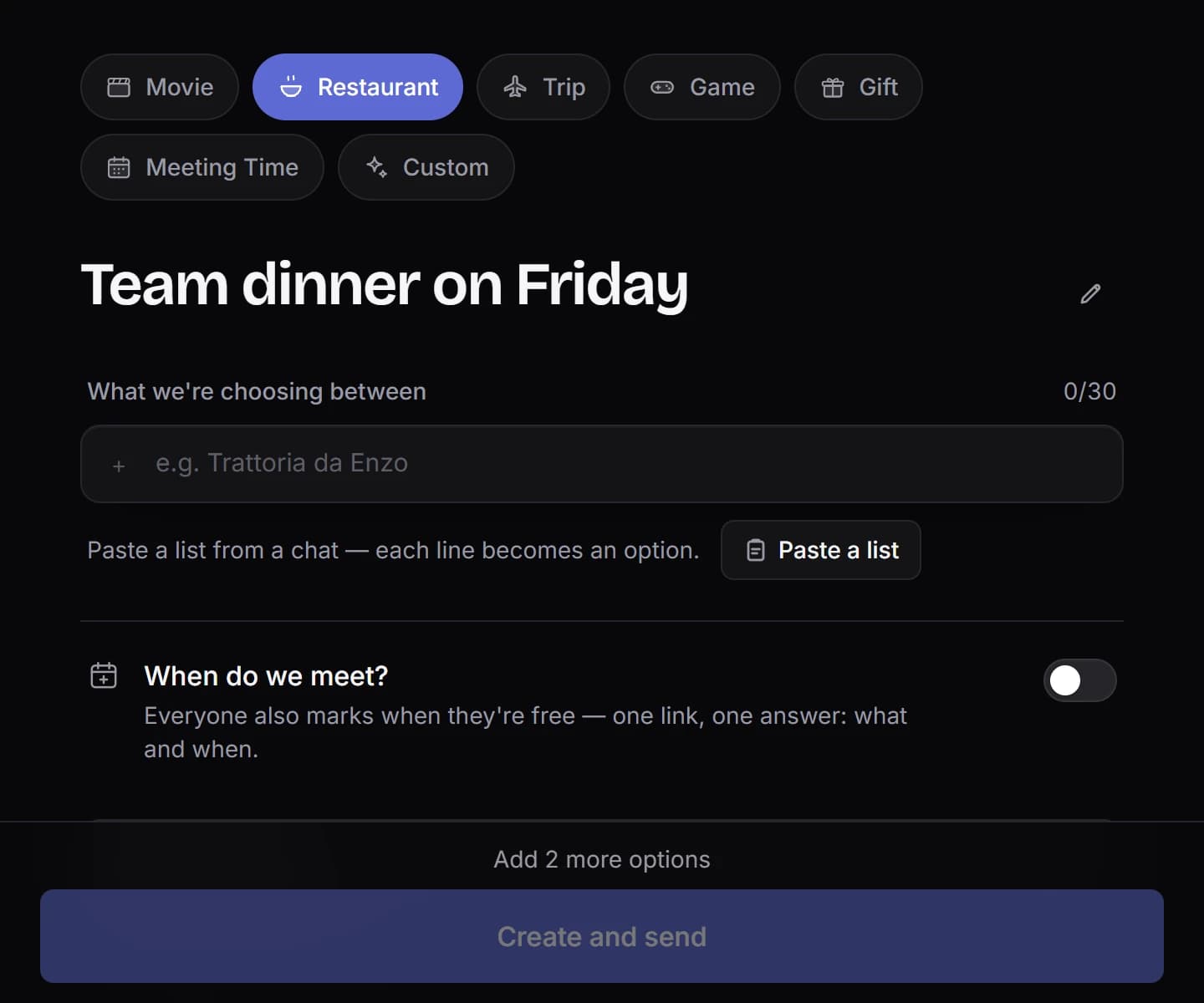
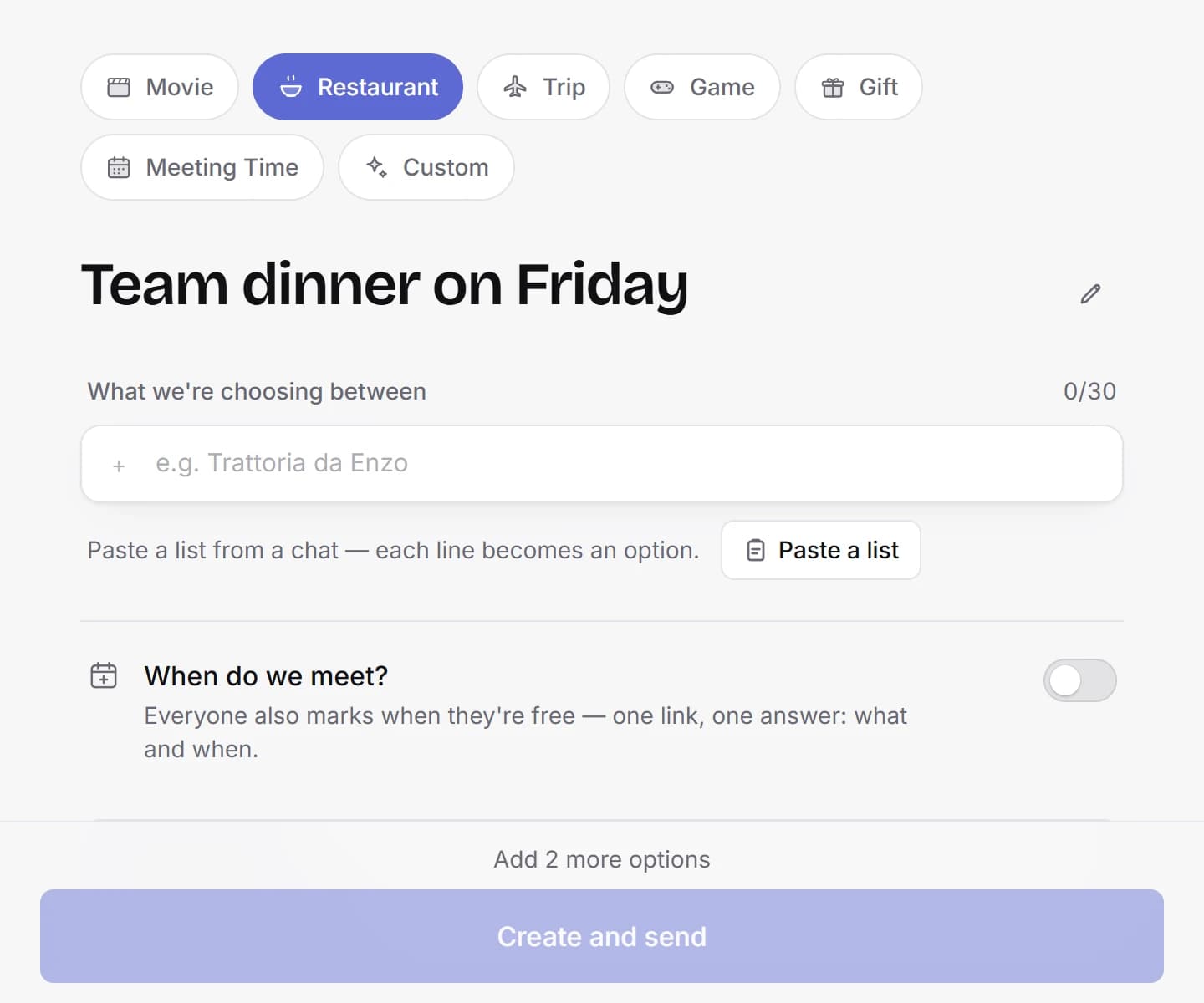
Pick a template — a film, dinner, a trip, a meeting time — and add the options. The questions come with the template, so nobody has to design a form, and for films, games and cities the catalogue fills in the details for you.
Nobody sees anybody else's answers, so the loudest voice in the chat doesn't decide for the group. An answer can be corrected: a new submission replaces the previous one entirely.
Compromise scores every option by how the whole group feels about it, then shows the winner, the runners-up and anything someone ruled out. Every line of the explanation comes from the answers, so you can see who is delighted and who is compromising.
FAQ
Questions people ask.
Not sure Compromise is the right thing for your group? Here are the answers people ask for most.
Creating a room and answering one is free, and neither needs an account. Sign in only if you want to find the rooms you made later, or be told when something happens in them. Pro adds rooms with no cap on people, recurring rooms, saved templates, email and VK notifications, reminders for anyone who hasn't answered, and letting someone else close a room for you.
No. A room opens from the link you send or from its eight-character code — no account, no app to install. A guest types a name and answers.
A poll counts votes and the majority wins, so the minority simply loses. Compromise scores every option against how each person feels about it — keen, indifferent or unhappy — and picks the one the whole group can actually live with.
Nobody sees anybody else's answers. The results page shows the group's decision and the reasoning behind it, so it can say that someone would have preferred something else — never how each person answered every question.
Yes, until the room closes. Answers are submitted as one batch and a new submission replaces the previous one completely, so a second pass is a correction and never a second vote.
Rule it out. A ruled-out option leaves the ranking entirely — no amount of enthusiasm from everybody else outranks it — and it is listed separately with the reason it was dropped.
From two of you up to a large group. Only finished questionnaires are scored, because a half-answered one would weigh in on some questions and not on others, and you can always see who you are still waiting on.
Yes. A meeting room asks for availability instead of options: everyone paints a calendar grid and the app offers the times that work, scoring each person by their worst moment in the meeting — attending most of it is not attending it.
The result is frozen at that moment and the link keeps working. Anyone who opens it later sees the same decision and the same explanation, even if the scoring rules change afterwards.